|
Hi SELF Family,
If you have kidney disease, someone has probably handed you a list of foods to limit because of phosphorus, and beans, lentils, nuts, and whole grains were on it. That list was built on how much phosphorus each food contains. What reaches your blood depends on how much of it you absorb, and that changes which foods belong on the list.
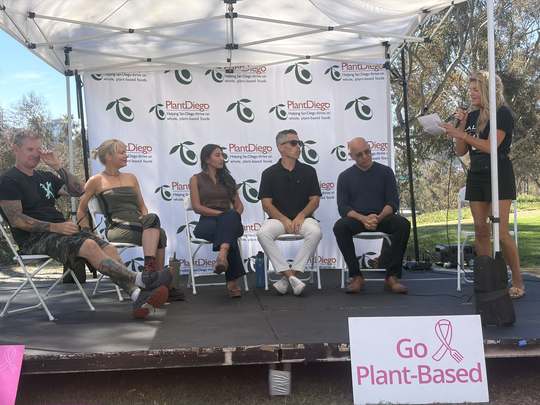
On Saturday I was on the main stage at San Diego VegFest, in Balboa Park, on a panel called Be Alive and Thrive. Before the panel, the organizers asked what I most wanted the audience to know. I sent them five things: fiber and the fullness hormone, a Stanford study of identical twins, building muscle on plants, a vegan diet for type 2 diabetes, and this one. It's the one I want to walk you through properly.
On the Be Alive and Thrive panel, and with my family. Balboa Park, San Diego, September 26.
Phosphorus is a mineral in almost everything you eat. Healthy kidneys clear what your body doesn't need, and as kidney function falls, phosphorus can build up in the blood, which is why your care team watches it. It reaches you in three forms, and your gut handles each one differently.
In beans, lentils, nuts, and seeds, phosphorus is held in phytate, the form plants use to store it, and the human gut absorbs phosphorus from phytate poorly, so less of it reaches your blood. The phosphorus in meat, dairy, and eggs isn't bound up that way, so more of it gets in. The third form is added in factories. Phosphate additives go into many processed and fast foods and some soft drinks, and a 2010 review in the Clinical Journal of the American Society of Nephrology describes this added phosphorus as more readily absorbed than the phosphorus that comes naturally with plant or animal protein. The same review notes that it may be underreported in nutrient databases.
A food list counts the phosphorus on your plate. Your blood only sees the phosphorus you absorb.
The cleanest test of this comes from Indiana University, published in the same journal. Researchers studied nine people with kidney disease whose eGFR, the kidney function number on a lab report, averaged 32. Each person ate a vegetarian diet for one week and a meat-based diet for another, with every meal prepared by the research staff and the two diets matched for nutrients. One week of the vegetarian diet led to lower blood phosphorus. The researchers concluded that counseling for people with kidney disease has to cover not only how much phosphorus they eat, but also which protein it comes from.
If you've spent years skipping lentils because a handout told you to, you did what you were asked to do. The handout was counting phosphorus on paper.
The added kind is the phosphorus to go after first.
On an ingredient label, it shows up as any word containing phos: sodium phosphate, phosphoric acid, calcium phosphate, and others. A 2012 review in Deutsches Ärzteblatt International concluded that this added phosphate can measurably raise blood phosphorus in people with advanced kidney disease. This week, turn over the three packaged foods you buy most often and read the ingredients for those letters.
Beans, lentils, and whole grains don't need to come off your plate by default. Potassium is a separate question. If yours runs high, which of those foods fit, and how much, is a conversation with your care team, and it's a different conversation from this one.
The video I made on phosphate additives shows where they hide, what high phosphate does to your arteries, and a kitchen trick that pulls phosphorus out of food. Watch Phosphate Additives: The Silent Arterial Killer Hiding in Fast Food.
On Tuesday, September 29, my interview for the Kidney Confidence Today Summit goes live. It's about GLP-1 medications, the drug family that includes Ozempic, and kidney disease: the benefits, the risks, and what patients should know.
The summit is free and online, hosted by renal dietitian Michelle McMurtery, RD. It runs on weekdays from Monday, September 28, through Tuesday, October 6. Each morning at 9 AM Eastern, which is 6 AM Pacific, two new interviews arrive by email, and each one stays up for 24 hours, so register before Tuesday morning if you want to catch mine.
Register free for the summit
With gratitude,
Dr. Sean
|